
Key takeaways
- Private wealth brings a higher volume of investors for the same capital, and each one needs the same onboarding and KYC checks as a single institution.
- Profitability depends on capacity: how many investors your operating model can serve before it needs more people.
- A guided digital investor journey, a connected tech stack and a supervised AI model that carries out repetitive tasks can help you to serve more investors without adding headcount at the same rate.
To onboard private wealth investors profitably in the era of evergreen funds, asset managers need more than an eligible fund structure. They need an operating model that can support smaller tickets and higher investor volumes without costs rising at the same pace.
In practice, that could mean moving onboarding, KYC checks and subscriptions out of email and PDFs and into guided digital workflows, with supervised AI handling repeatable tasks like identity verification.
Why is private wealth such a big opportunity for asset managers?
Private wealth is becoming one of the most important growth opportunities in private markets. Law firm Macfarlanes puts the addressable private wealth market in Europe’s four largest economies at €9.1tn. State Street surveyed 500 institutional investors in 2025. 56% expected at least half of private market flows to come through semi-liquid, retail-style vehicles within two years.
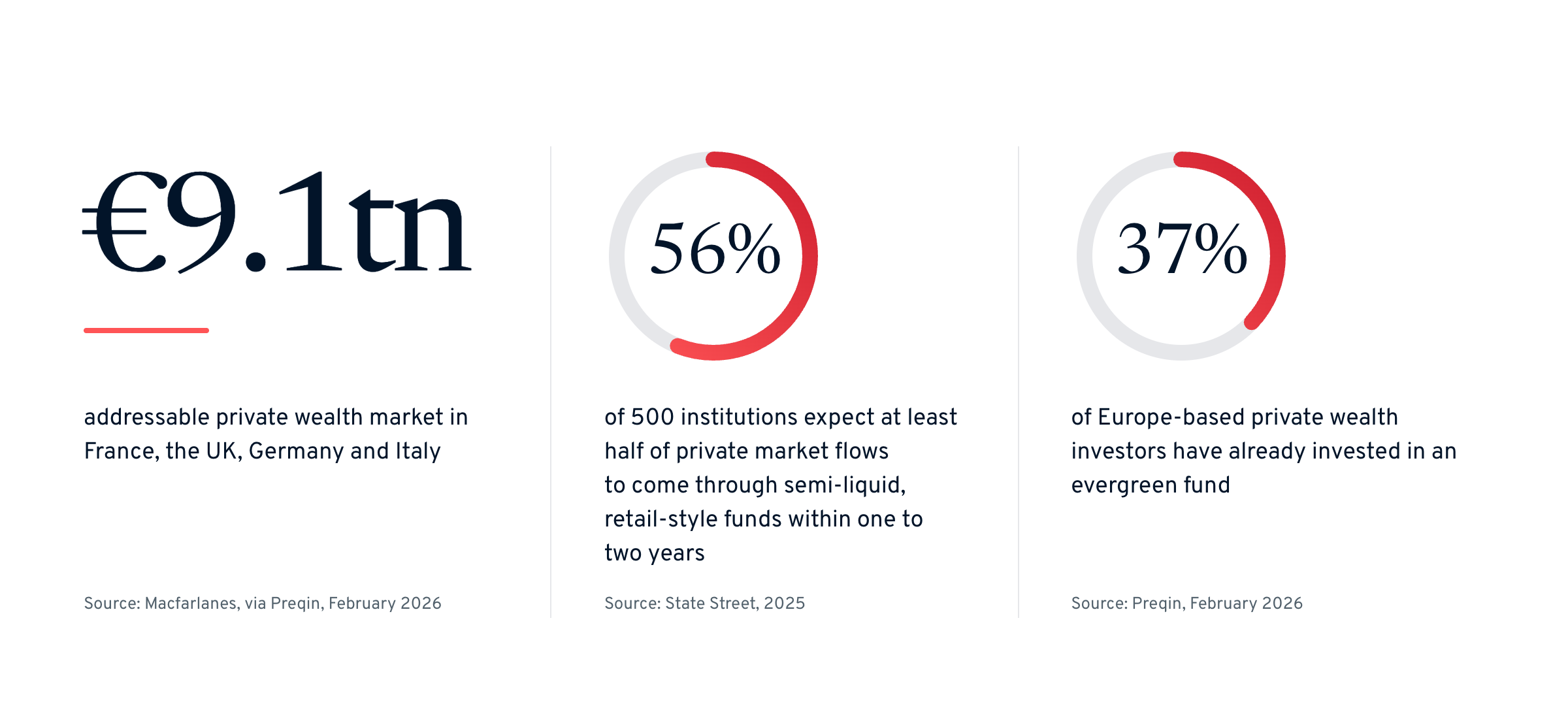
Investor demand is already there. In 2026, Preqin found that 37% of Europe-based private wealth investors had already invested in an evergreen fund, and another 24% were actively looking.
The question is how managers can serve these investors at scale while protecting their margins. (For more on the market forces behind this shift, read The shift to private wealth: Why it matters for wealth managers.)
Why is private wealth fundraising harder than institutional fundraising?
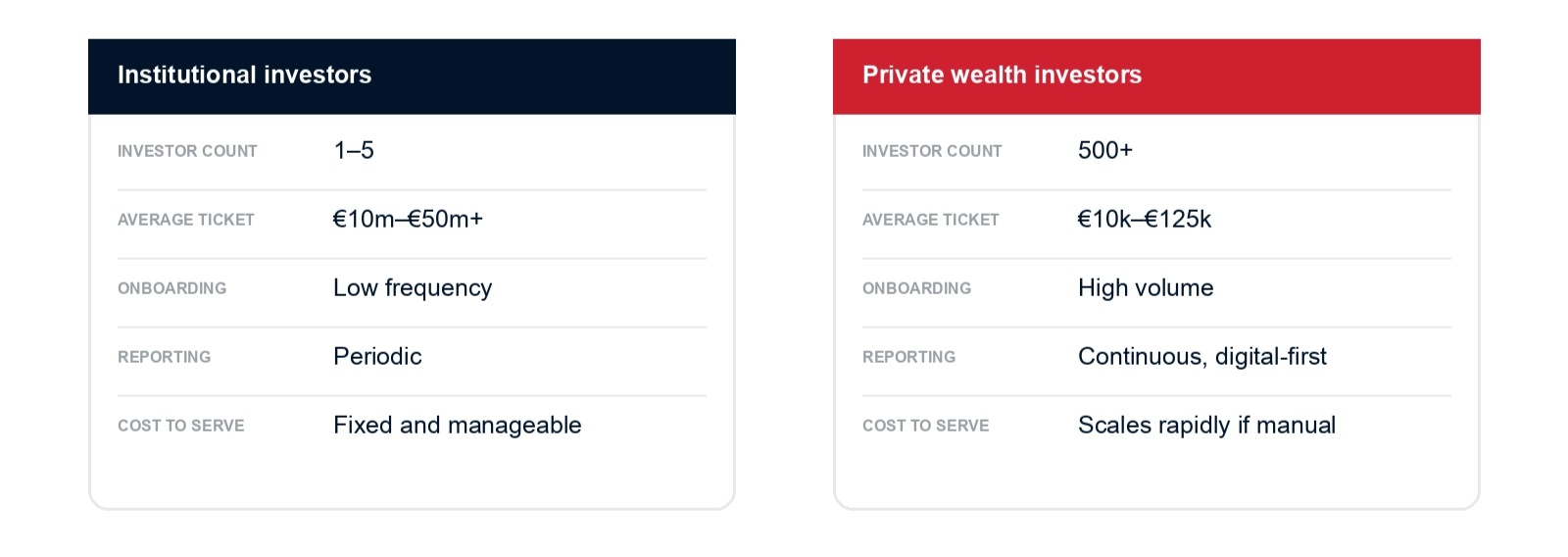
Institutional fundraising is concentrated: a few investors writing large tickets. Private wealth flips that. The same AUM target may require hundreds or thousands of investors, and each still needs:
- Onboarding and document collection
- Identity, AML and KYC checks
- Eligibility assessments
- Subscription and transaction processing
- Reporting, communications and ongoing support
The manual work is the same regardless of ticket size, so thousands of small investors drain operational resources far faster than a handful of institutions. Evergreen structures add to the load: subscriptions, redemptions, liquidity windows and reporting become ongoing rather than limited to a single fundraising period.
How does ticket size affect the cost to serve each investor?
The smaller the ticket, the higher the cost to serve for each $1mn raised. In a manual environment, onboarding costs can eat into the management fee before capital is even deployed. Here’s the same $50mn raised two ways:
| Institutional investors | Private wealth investors | |
| Commitment amount | $50mn | $50mn |
| Ticket size | $50mn | $50,000 |
| Investor count | 1 (pension fund) | 1,000 (individual investors) |
| KYC checks needed | 1 | 1,000 |
Manual processes also create friction with distribution partners who expect a seamless user experience. PDF forms and email workflows can lead to:
- high error rates, as data is re-keyed between systems
- slow capital deployment, as the gap between commitment and settlement widens
- a poor experience for digitally savvy high-net-worth individuals (HNWIs)
Attracting wealth demand is rarely the hard part. The real challenge is servicing it without turning every new investor into a new cost centre. With fees compressing and competition rising, hiring through the problem isn’t an answer: if every new investor needs more operations headcount, private wealth growth dilutes margins even as AUM rises.
How can asset managers access private capital profitably?
Profitability comes down to capacity: how many investors your operating model can onboard and service before it needs more people.
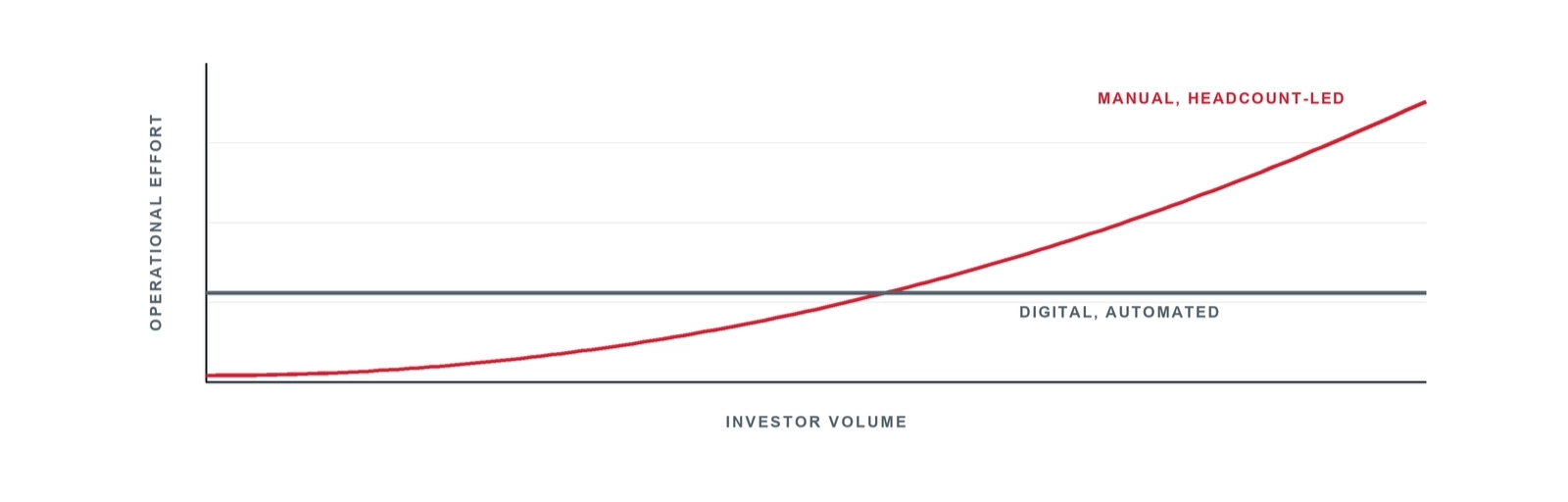
Digital capacity changes the cost curve, allowing operational effort to grow more slowly than investor volume.
The answer is digital-first infrastructure that supports scale from the outset. That means bringing onboarding, compliance, subscriptions, transactions and reporting into one connected environment, linked to the systems you already run, such as your CRM, fund accounting and transfer agency platforms. Data flows between them without re-keying, and everyone works from a single source of truth.
A scalable operating model should include:
| Digital, guided onboarding | Investors can complete onboarding through a clear digital journey, with structured data capture and automated document collection replacing fragmented email and PDF workflows. |
| AI-assisted compliance | AI can extract data, review documents and support multi-jurisdictional AML/KYC checks. Human teams remain responsible for reviewing AI-generated outputs, but spend less time on repetitive administration. |
| Centralised investor data | A single source of truth helps managers track onboarding, transactions, capital activity, reporting, and servicing across channels. This becomes essential as investor and distributor numbers grow. |
| Repeatable evergreen workflows | Subscriptions, redemptions and liquidity windows need controlled, auditable processes that can run repeatedly. |
| Digital-first investor servicing |
Private wealth investors and their advisers expect timely information, transparency, and easy access. A scalable service model should provide this without relying on manual responses for every request. |
How can AI help firms service private wealth?
Digitisation removes the paperwork, but much of onboarding is still high-volume document work that follows clear rules. That’s where AI is most useful. It can:
- recognise each document an investor uploads, such as a passport, proof of address or bank statement
- extract the details your forms need, such as names, dates of birth and addresses, so nobody has to re-key them
- check those details against each other and flag mismatches, missing pages or expired documents
- read ownership structure charts for investors who invest through companies, trusts or family vehicles, and map who owns and controls them
Institutions are already moving in this direction. In the same State Street survey, 83% of institutions were planning use cases for generative AI to turn unstructured private markets information into data they can analyse.
This doesn’t mean giving up control. In a regulated process, the model that works is supervised AI: the AI prepares the work and a person approves it. Your team keeps every risk decision, and an audit trail records each approval.
Goji’s AI assistant, purpose-built for private fund operations, works exactly this way. It identifies each uploaded document, extracts and validates the KYC data, and turns ownership charts into entity maps by cross-referencing public registries. Nothing is committed to the platform until your team approves it.
Where can managers expand private wealth access?
Most managers reach private wealth through distribution partners, such as private banks, wealth platforms and advisers, or through feeder funds that pool smaller allocations into a single investor. But these routes don’t capture every viable investor: some tickets are too small to justify the cost of onboarding and servicing.
A lower-cost, digital operating model can make these smaller direct investors viable, opening up a broader pool of demand alongside existing partner and feeder-fund channels.
How does Goji help?
Goji, part of the Euroclear group, provides the technology and infrastructure to support direct investors in private market funds. Our platform helps managers:
- scale without matching headcount growth, using supervised AI and guided digital onboarding
- manage onboarding, subscriptions, transactions and reporting on one platform that integrates with your existing tech stack
- offer direct-to-fund access through a white-label onboarding journey
- reach more distributors through Euroclear FundsPlace

The shift to private wealth is a generational opportunity for growth. Managers that win direct private wealth capital will make the investor experience simple while keeping operations controlled behind the scenes.
At Goji, we help asset managers build that model. See how StepStone onboards wealth investors into its evergreen funds with our technology. If you’re exploring direct investor access, we can help assess whether your operations are ready for private wealth scale and identify where automation could protect your margins.
Weighing up how to service private wealth at scale?
Most managers we speak to are still comparing options: build in-house, extend existing partners, or bring in digital infrastructure. A short, no-obligation review is the fastest way to see where the cost to serve actually sits in your model.
- Book a 30-minute call with our team. We can talk through your current investor lifecycle and highlight the steps driving the most manual effort.
- Explore the platform. See how digital onboarding, AI-assisted AML/KYC, and evergreen workflows look in practice.